

Who This Works Best For
This approach is most effective when alignment can no longer be maintained informally.
Organizations reach this point when decisions reopen after being “settled,” priorities drift under pressure, and execution depends more on personalities than structure. Leadership spends more time re-deciding than moving forward.
If alignment holds only while conditions are stable, this system is designed for that moment.
The Problem This Solves
Most organizations don’t struggle because they lack intelligence, commitment, or vision.
They struggle because decisions are hard to resolve — and once resolved, hard to hold.
As complexity increases:
The same strategic issues resurface.
Decisions reopen as conditions change.
Accountability becomes political instead of operational.
Execution slows as tradeoffs are revisited.
Plans may exist, but they don’t reliably guide action. Alignment is negotiated rather than structurally resolved
What Changes After the Work
After this work, organizations operate with greater clarity and stability — not because everyone agrees, but because decisions are grounded in shared analysis.
What changes is visible:
Analysis becomes trusted because it is shared and explicit
Decisions hold because tradeoffs are resolved, not deferred
Alignment persists without constant reinforcement
Execution stabilizes because teams work from the same logic
Meetings shift from persuasion to decision. Work moves forward without reopening fundamental questions.
What Kind of Engagement This Is
This is not a facilitation-only engagement, and it does not end with a strategy document.
The work is designed to install a repeatable decision and alignment system that leaders and teams can reuse. We guide the initial work closely, then help organizations apply the same logic across leadership teams, departments, and ongoing decisions.
The objective is capability — not dependency.
Why Strategy So Often Fails
Alignment fails when ego substitutes for analysis.
By ego-based decisions, we do not mean bad intent or personality. We mean decisions ultimately settled by authority, persistence, or influence rather than by a structured resolution of competing priorities.
Ego-proofing allows discussion and advocacy. It replaces open-ended negotiation with a disciplined prioritization process that forces explicit tradeoffs and produces alignment.
If you’d like a deeper explanation of why traditional planning breaks down under pressure, we explain the logic Here.
The Ego-Proof Decision Alignment System
The Ego-Proof Decision Alignment System reverses the traditional planning sequence.
Instead of starting with competing visions or preferences, the work begins with strategic issue mapping — identifying the limited set of issues that genuinely require leadership decision.
Each issue is evaluated using a shared analytical framework, so alignment is built through analysis rather than persuasion.
For readers who want a fuller explanation of how issue-first decision systems work in practice, see details Here.
The Planning and Alignment Process
The system is intentionally simple — and disciplined.
Constituent Input and Context
Structured input, interviews, and background research establish a shared factual baseline and surface misalignment early.
Organizations often begin with a one-hour alignment conversation supported by a brief pre-session survey. You can request this through the contact page Here.
Strategic Issue Mapping
Leadership identifies and frames the issues that truly require decision, rather than debating solutions prematurely.
Forced Prioritization
Issues are ranked through a structured process that requires compromise and makes tradeoffs explicit.
Decision Framework Application
Each priority is evaluated against:
• Mission fit
• Core values
• Constituent needs
• Capacity and resources
• Risks and tradeoffs
Direction and Commitment
Clear commitments emerge because the analysis is shared and tradeoffs are resolved.
Execution Translation
Decisions translate directly into programs, initiatives, and operational work.
How Alignment Cascades Through the Organization
The same decision logic is reused beyond the leadership team.
Departments, teams, and projects apply the same issue-based framework to their own decisions. Alignment no longer depends on authority or repetition — it holds because the logic is shared.
How the Ego-Proof System Actually Works
Once strategic issues are identified, each issue is evaluated using the same analytical framework—grounded in mission, values, constituent needs, capacity, and tradeoffs. The result is aligned decisions that can be cascaded and executed consistently.
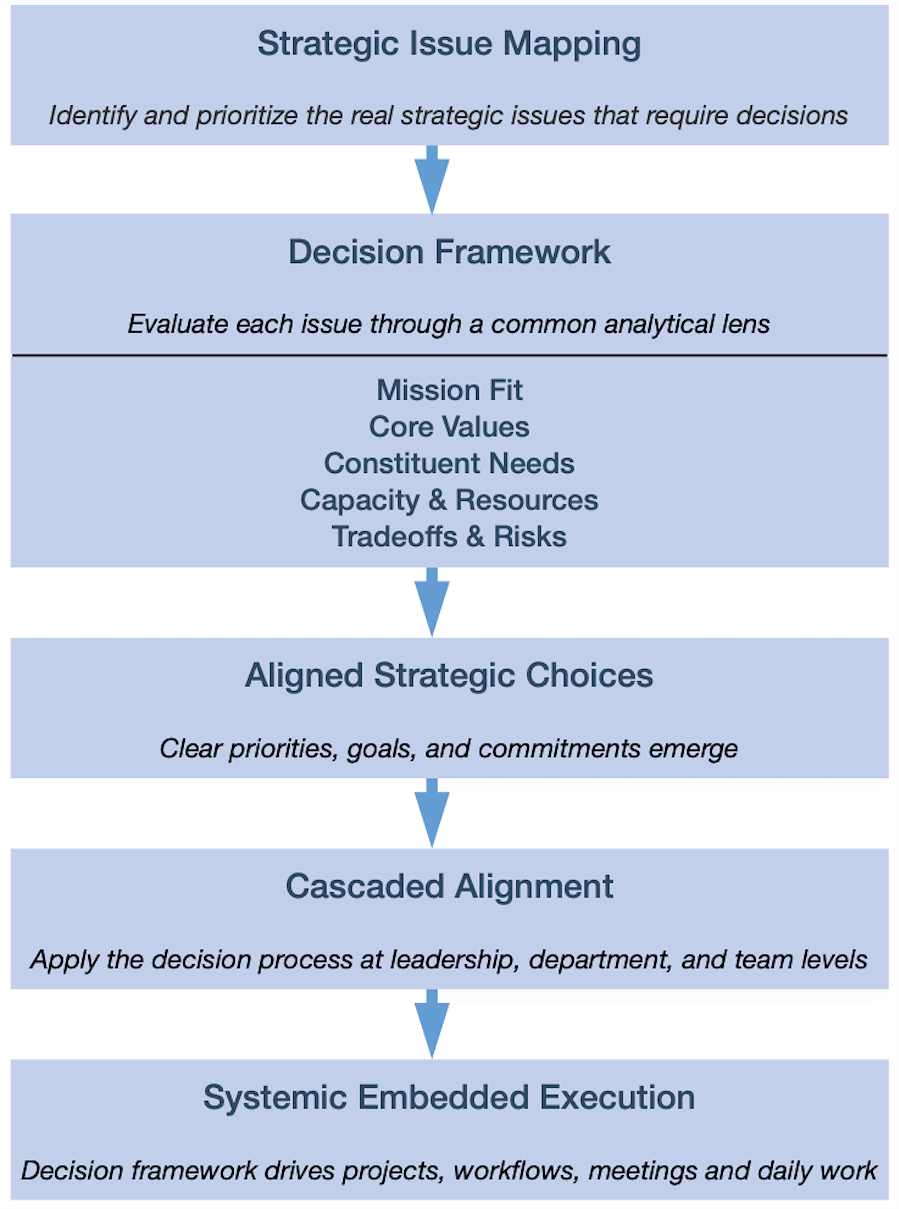
Because the same framework is used at every level, alignment does not depend on authority or repetition. Decisions hold because they are grounded in shared analysis rather than individual preference.
How to Begin
Most organizations begin with a no-obligation working conversation focused on their current decision and alignment challenges.
This is not a sales call. It is a structured discussion designed to:
Surface where decisions are stalling or reopening
Clarify whether misalignment is a systems issue or a situational one
Determine whether an ego-proof approach would be useful
In many cases, this conversation is supported by a brief pre-session survey to ground the discussion in shared input rather than opinion.
Start with a conversation, not a plan.
If it’s clear that the work is not a fit, we say so.
If it is, we outline a practical next step.
To explore whether this approach applies to your situation, contact us to request an initial alignment conversation Here.